Have you ever put on an outfit that looked perfectly fine... until you added the right shoes, a jacket, or a watch? Then... wowzers!
Suddenly it wasn't just an outfit anymore. It was an ensemble where every piece just clicked. The funny thing is, nobody compliments the belt.
They compliment the overall look. Exhibits aren't much different.
The display structure usually gets most of the attention, and rightfully so. It's the centerpiece. But just like a great outfit isn't defined by one piece of clothing, a great exhibit isn't defined by its walls and graphics alone.
It's the flooring that grounds the space, the furniture that makes conversations more comfortable, the lighting that draws your eye to the right places, the mix of materials that adds depth, and even the greenery that makes the environment feel a little less like a convention center and a little more welcoming.
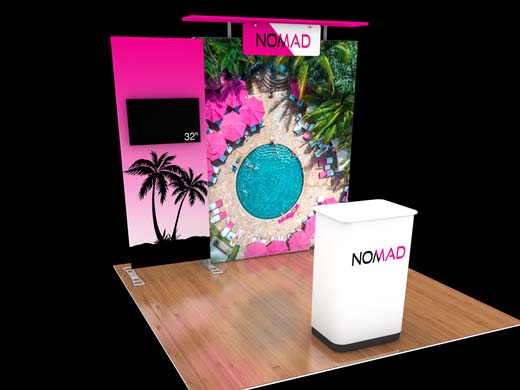
Individually, none of these elements are the star of the show. Together, they're what make an exhibit feel complete and ready for the red carpet.

Flooring Does More Than Cover the Floor
No one has ever walked into an exhibit and said, "Wow, nice carpet." If they did, your sales team probably has bigger problems. But people absolutely notice when the flooring feels like an afterthought.
The right flooring helps define your exhibit, creates a visual boundary, complements your branding, and gives the entire space a more finished appearance. It also happens to make standing through a three-day trade show a little easier on your team, which becomes increasingly important somewhere around Hour Seven.
Furniture Influences How People Interact
Furniture isn't simply there to give people a place to sit.
It quietly influences behavior.
A café table encourages a quick conversation. Lounge seating invites visitors to get comfortable and stay a little longer. A reception counter creates a natural place to welcome people into the exhibit.
When furniture is selected with intention, it becomes part of the experience instead of something that fills empty corners.
Lighting Sets the Mood
Think about the difference between a restaurant with harsh fluorescent lights and one with warm, carefully placed lighting.
Same food. Completely different experience. Exhibit lighting works the same way.
Good lighting highlights products, emphasizes graphics, creates depth, and naturally guides visitors through the space. It doesn't need to flash or change colors every five seconds to get attention. More often, the best lighting is the kind people barely notice because it simply feels right.
Texture Makes an Exhibit Feel Designed
This is one of the most overlooked details in exhibit design.
Walk through an exhibit that combines woodgrain finishes, fabric, acrylic, metal, dimensional graphics, and other materials, and you'll probably describe it as polished, modern, or high-end.
You probably won't say, "I really appreciated the laminate selection." That's because texture works subtly.
It creates visual interest, introduces contrast, and gives the exhibit personality in subtle ways people may never consciously notice. Below is the same exhibit shown with three different design palettes. Notice how changing the materials, finishes, and styling completely changes the personality of the space.
Greenery Softens the Space
Plants may not be the first thing that comes to mind when planning an exhibit, but they can completely change how a space feels.
A well-placed planter can soften hard lines, separate meeting areas, and make an environment feel more inviting. Decorative elements can have the same effect. They're rarely the reason someone stops by your exhibit, but they often contribute to the impression people leave with.
Sometimes it's the smallest details that make a space feel the most comfortable and inviting.
Great Exhibits Aren't Built One Piece at a Time
One of the biggest misconceptions about exhibit design is that it's a collection of individual decisions.
→ Choose the display.
→ Pick the furniture.
→ Order the flooring.
→ Add a few lights.
In reality, the best exhibits aren't assembled like a shopping list. They're designed as complete environments where every element supports the next.
That's why the finishing touches matter.
Not because any one of them steals the spotlight, but because together they create an experience that's comfortable, cohesive, and memorable.
Great exhibits aren't remembered for one impressive feature. They're remembered because everything worked together. Every detail supported the overall look.
Just like a great outfit, it's the finishing touches that pull everything together.